With baseball season in full swing, soccer bringing fans together this summer, and football season just around the corner, it’s a big time for sports in the U.S. So, this week we’re taking a look at a few stadiums that stand out for more than what happens on the field.
Fenway Park
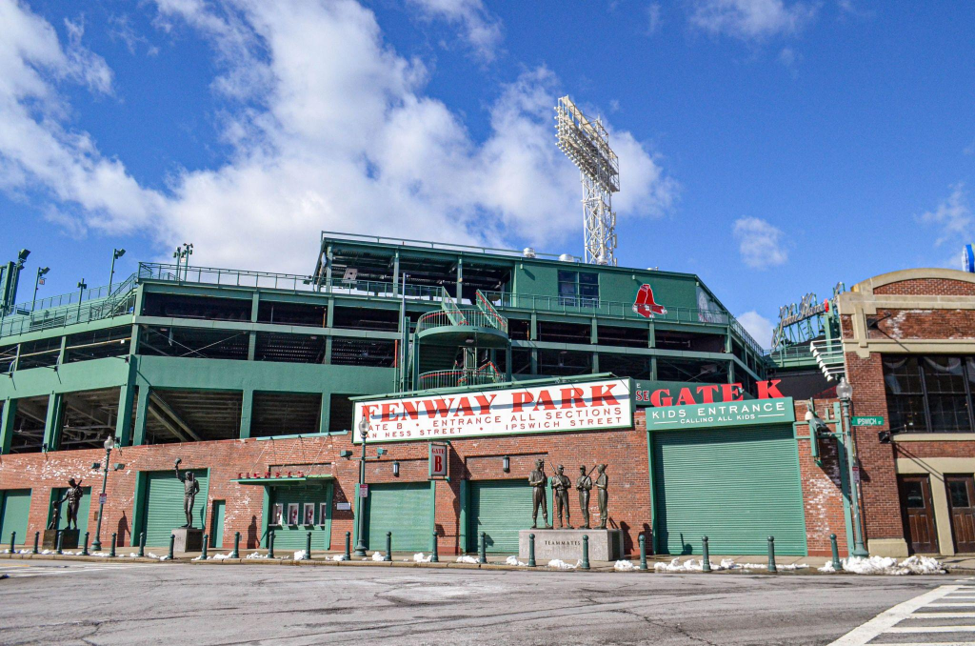
One of the most recognizable sports venues in the country is the iconic Fenway Park, located in Boston, Massachusetts. Opened in 1912, it is the oldest active baseball stadium in the U.S., which means maintaining the structure while still preserving its historic character is a unique challenge.
The only major renovation the stadium has undergone was in 1934, when the addition of a 37-foot wall with a 23-1/2-foot tall wire mesh screen on top was constructed in the left field. After it was painted green in 1947, this wall has been referred to as “The Green Monster.”
In the late 90s, the owners of the Boston Red Sox wanted to demolish the stadium and build a new one to add more seats, luxury boxes, and amenities. Opposed to the stadium’s demolition, the Boston Preservation Alliance joined neighborhood advocates in 1998 to form Save Fenway Park! (SFP!), a coalition dedicated to preserving the ballpark while allowing for needed renovation such as additional seating that would not destroy historic elements. . Through public campaigns, rallies, canvassing, and community outreach, the coalition gained widespread support, secured a National Trust Preservation Grant, and helped place Fenway Park on Historic Massachusetts’ Ten Most Endangered Historic Resources list. In 2005, the Red Sox announced that Fenway would remain their permanent home, recognizing efforts by SFP! that renovating the historic ballpark could meet the needs of a contemporary ballpark without incurring the cost of building a new one. In 2012, Fenway Park earned its place on the National Register of Historic Places, formally celebrating its significance as an enduring piece of American architectural sports history.
SoFi Stadium
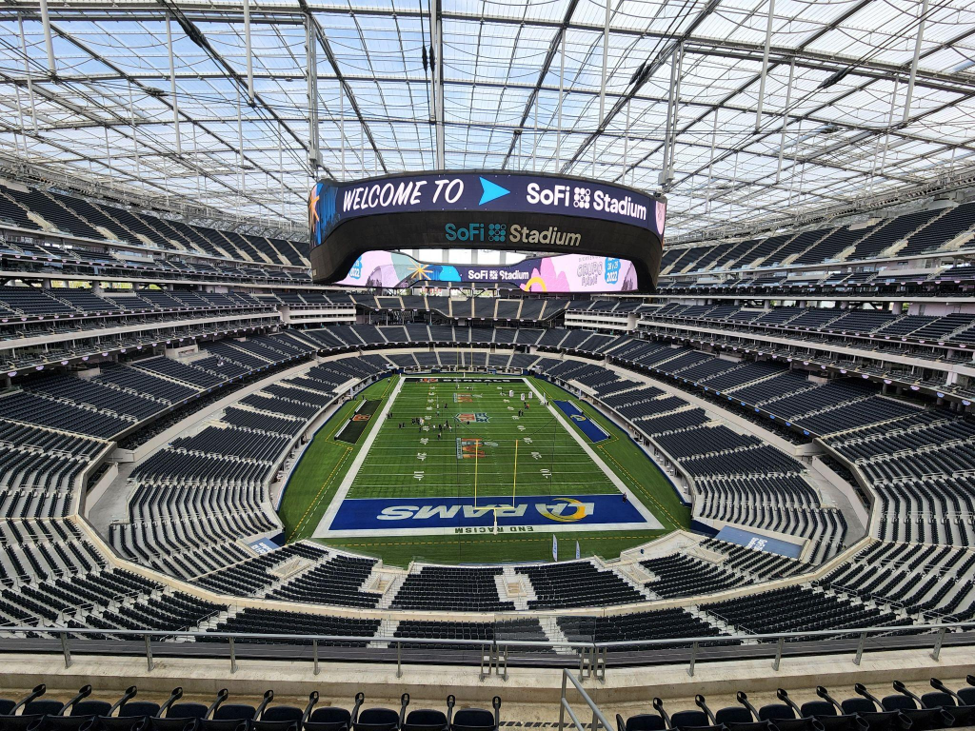
While Fenway Park represents architectural design and engineering through preservation, SoFi Stadium demonstrates what’s possible when the stadium is reimagined from the ground up. SoFi Stadium, located in Inglewood, California, opened in 2020 and was designed by global architecture firm HKS. This stadium features a massive ETFE roof that spans approximately one million square feet across the main bowl, the adjacent performance venue, and the surrounding public spaces. ETFE stands for ethylene tetrafluoroethylene, which is a lightweight, highly durable plastic film that architects and engineers use as an alternative to traditional glass or heavier roofing materials. The design intent was to make the stadium an indoor-outdoor venue, rather than enclosing the stadium with a traditional roof and walls.The ETFE consists of panels that are joined to form a massive canopy that provides shelter while allowing natural light into the space. This also provides protection from the elements while leaving the sides of the stadium open to the surrounding environment. The lightweight design reduces the amount of structural material required to support the canopy, while its durability and relatively low maintenance requirements can contribute to a longer service life.
These characteristics make ETFE an environmentally sustainable and aesthetically pleasing option for large-scale infrastructure projects where both performance and long-term efficiency are important considerations.
US Bank Stadium
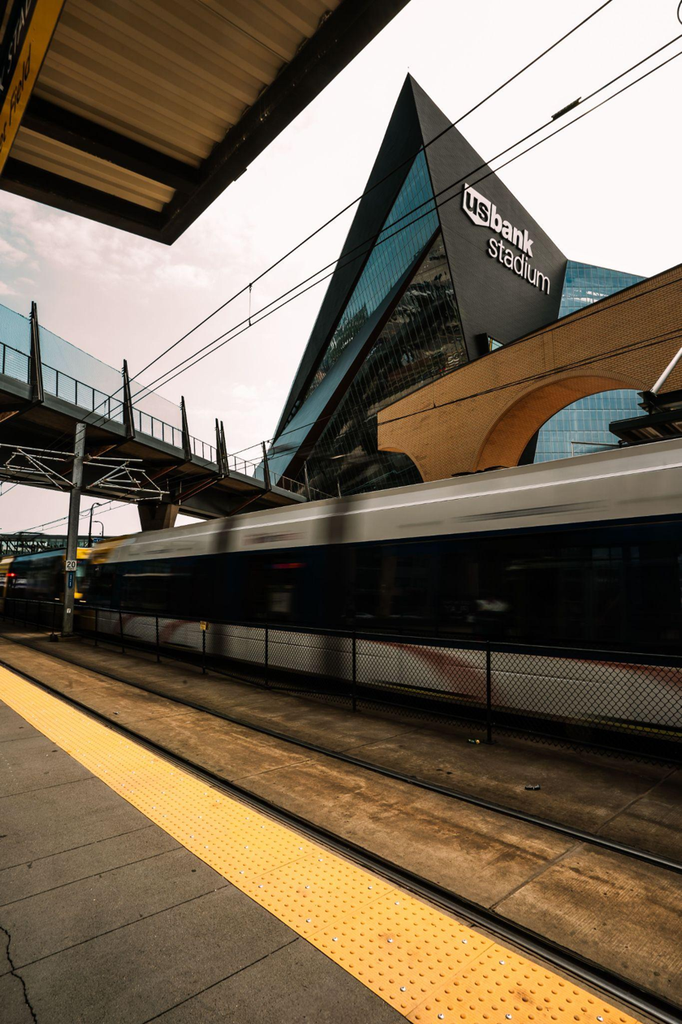
Unlike SoFi Stadium, which takes advantage of Southern California’s mild climate, U.S. Bank Stadium in Minneapolis was designed with Minnesota’s harsh winters in mind.
Its steeply sloped glass roof allows snow and ice to slide toward catch basins around the roof’s perimeter rather than accumulate on the structure. With winter temperatures often remaining below freezing for extended periods, engineers also incorporated a snow- and ice-melting system into the concrete catch basins. The system is divided into six independently controlled zones that can adjust to changes in sunlight, wind, snowfall, and temperature, helping prevent accumulation more than 100 feet above the ground.
This approach was especially important since the U.S. Bank Stadium replaced Hubert H. Humphrey Metrodome, the roof of which collapsed under the weight of heavy snow and wind in 2010.
The Astrodome
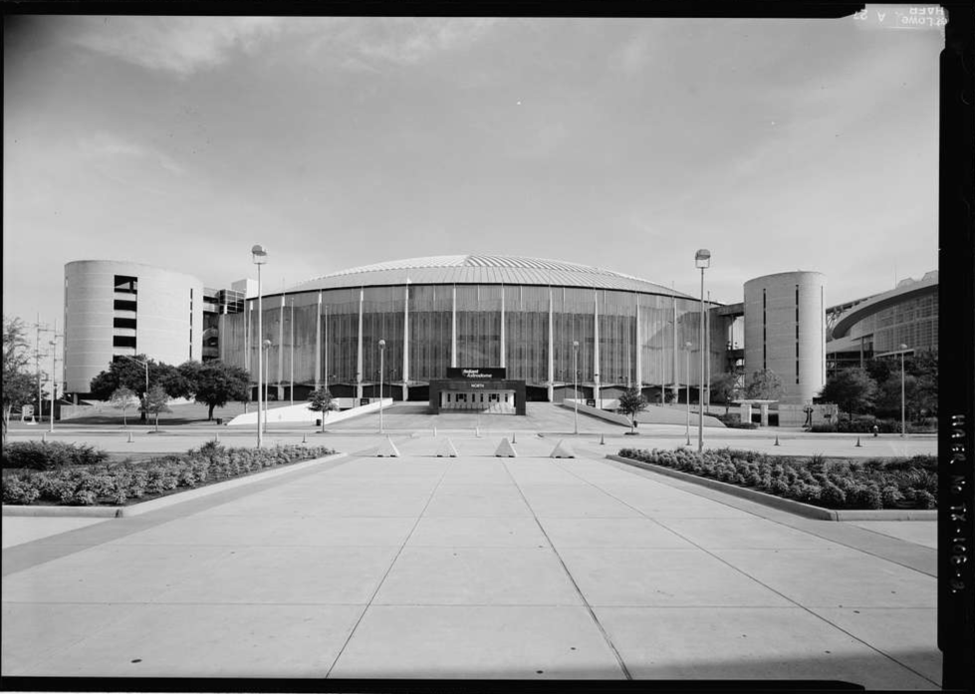
When The Astrodome, located in Houston, Texas, was opened in 1965, it was nicknamed the “Eighth Wonder of the World.” As the world’s first domed, air-conditioned sports stadium, the 18-story structure marked a major shift in stadium design and construction.
The stadium’s enclosed design, however, created an unexpected problem. The original translucent roof panels allowed natural light into the stadium, but sunlight reflecting off the surface made it difficult for baseball players to track fly balls. To reduce the glare, the panels were eventually painted, which in turn significantly reduced the amount of natural light reaching the field. Because natural grass could no longer grow successfully indoors, the Astrodome turned to an artificial playing surface. Installed in 1966, the new synthetic grass was developed specifically for the Astrodome and became known as AstroTurf.
Recognized for its architectural and engineering significance, the Houston Astrodome was added to the National Register of Historic Places in 2014.
Nu Stadium
Adding to the evolution of stadium design is Inter Miami’s Nu Stadium, which features a tension ring canopy that is the first of its kind in the United States. Designed by German structural engineering firm Schlaich Bergermann Partner (sbp), the canopy uses a tension-based structural system to create a large covered area while maintaining a lightweight, open appearance.
This type of structure relies on two opposing forces: tension and compression. Tension pulls materials apart, while compression pushes them together, and the two forces often work together to create a stable structure. Similar principles can be found in everyday objects such as tennis rackets and bicycle wheels.
The tension-ring design is similar to these concepts, but on a much larger scale. In a tennis racket, cables are stretched between a solid frame that supports them. A bicycle wheel uses a more complex system, with the inner hub and outer rim working together to distribute forces through the spokes. The stadium canopy applies these same principles to create a large, lightweight structure supported by carefully balanced forces.
Cable net structures can be more cost-effective than traditional cantilevered steel roofs because they are significantly lighter. A lighter structure requires less material, smaller foundations, less heavy equipment, and faster installation, all of which can reduce construction costs.
Nu Stadium’s canopy demonstrates how rethinking traditional structural systems can lead to a lighter, more efficient, and more cost-effective solution.
To learn more about Nu Stadium, you can visit their website here: Nu Stadium – Home of Inter Miami CF at Miami Freedom Park
Bernabéu Stadium
While the stadiums discussed so far are here in the U.S., some of the most interesting examples of stadium engineering can be found in other parts of the world. One standout is the Santiago Bernabéu Stadium in Madrid, Spain.
Rather than demolishing the 1947 stadium and starting from scratch, the soccer organization, Real Madrid, undertook a massive renovation from 2019-2024 to modernize the stadium and turn it into a multipurpose venue.
One of the renovation’s most impressive features is its retractable pitch. Automated trays, tracks, and hydraulic systems allow the entire grass field to be lowered 30 meters underground, enabling the stadium to host events beyond soccer. While stored below the stadium, the grass is maintained with specialized grow lights, irrigation, and climate control. Other noticeable features are the stadium’s new façade, which wraps the original Brutalist concrete structure in approximately 7,500 V-shaped stainless steel slats, and a skywalk with views of Madrid and a 360-degree video scoreboard.
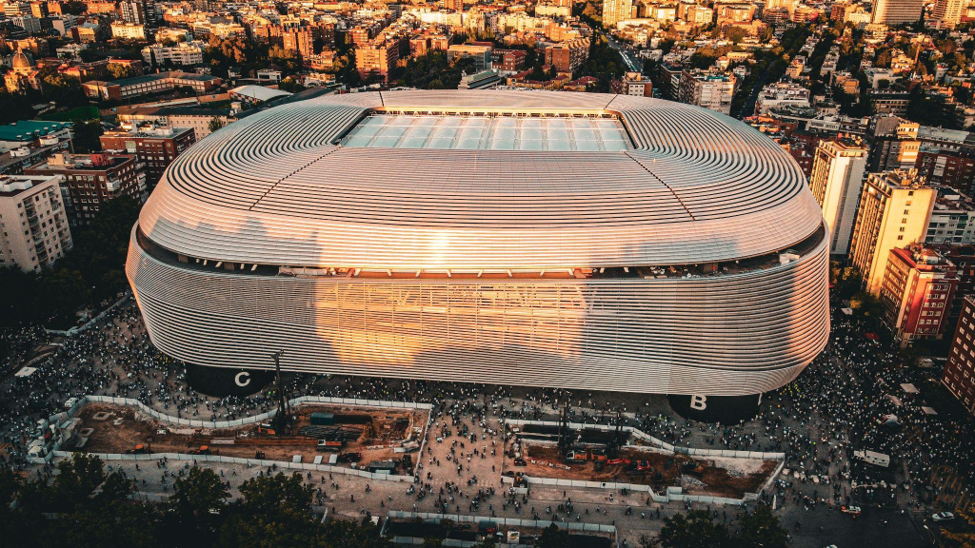
From historic preservation to innovative structural systems, each of these stadiums reflects a unique melding of architectural and engineering design, groundbreaking solutions to the difficult problems of creating a collective space where thousands of people can come together to experience the game.
References:
- Fenway Park | Boston Preservation Alliance
- SoFi Stadium and the Engineering Behind Modern Stadium Design – AGC Chemicals Europe
- Sports Complexes – Case Study – U.S. Bank Stadium
- A tennis racket, or a bicycle wheel? Inter Miami’s Nu Stadium highlights cost-saving tension-ring canopy concept
- The Astrodome | National Trust for Historic Preservation Renovating The Santiago Bernabeu Stadium: Engineering Facts | Institution of Civil Engineers (ICE)