How Bridge Engineering Evolved in America Over the Last 250 Years
It’s easy to take bridges for granted. We cross them on our morning commute, weekend road trips, and daily errands without a second thought. Currently, there are over 560,000 bridges across the United States. Each bridge, whether it’s a small rural crossing, or an iconic suspension bridge over a major waterway, is the product of careful planning and meticulous design.
As the United States marks its 250th anniversary, it’s an opportunity to celebrate not only the people and events that shaped the nation, but also the engineering achievements that made its growth possible. Among the most enduring of these achievements are America’s bridges, which have connected communities, supported commerce, and pushed the boundaries of engineering.
Each period in American history has its engineering marvels. By looking back at some of the country’s most iconic bridges, we can trace the evolution of bridge design over the last 250 years.
Contemporary Bridges
The Margaret Hunt Hill Bridge in Dallas, Texas, is a striking example of contemporary bridge engineering, demonstrating how modern design can seamlessly blend structural performance with architectural beauty.
Designed by renowned architect and engineer Santiago Calatrava, the cable-stayed bridge spans the Trinity River, connecting downtown Dallas with the revitalized neighborhoods of West Dallas while serving as a centerpiece of the city’s ongoing redevelopment. Its defining feature is a 446-foot white steel arch that has become an iconic part of the Dallas skyline. More than a visual landmark, the arch supports the bridge deck through a network of 58 steel cables, creating a structure that is both efficient and elegant.

Bridges like the Margaret Hunt Hill Bridge represent just one example of how far bridge engineering has advanced. Today, engineers use sophisticated computer modeling to simulate structural performance before construction even begins, while drones and other inspection technologies allow existing bridge conditions to be assessed more safely and efficiently. Advances in high-performance concrete, corrosion-resistant materials, and rehabilitation techniques have also extended the service life of bridges, allowing many structures to be repaired and strengthened rather than replaced entirely.
The Interstate Highway Era
As transportation needs grew in America post World War II, President Dwight D. Eisenhower created the Federal-Aid Highway Act of 1956, which authorized and created federal funds for the construction of the Interstate Highway System. The legislation launched the largest public works project in American history. Through this act, engineers were challenged to build bridges capable of carrying increasing traffic volumes, while also connecting communities that were separated by complex terrain.
One of the most remarkable projects of this period was the Chesapeake Bay Bridge–Tunnel, which opened in 1964 and connected Virginia’s Eastern Shore with the mainland across nearly
18 miles of open water. Rather than constructing a traditional bridge from shore to shore, engineers designed a hybrid system of bridges, tunnels, and artificial islands, so that motorists could travel across the Chesapeake Bay without disturbing the shipping channels for large naval vessels and commercial traffic.
To construct the underwater tunnels, engineers excavated trenches along the bay floor before lowering prefabricated tunnel sections into place from barges. Divers carefully aligned and connected each section, after which the tunnels were sealed and covered with earth to protect them beneath the bay. The bridge portions of the crossing consist of long, low-level trestles and two higher bridge spans, all connected by four man-made islands that serve as transition points between the bridges and tunnels. To this day, the Chesapeake Bay Bridge–Tunnel remains critical for the Eastern Shore, carrying about 11,000 vehicles each day.
The American Society of Civil Engineers recognized the Chesapeake Bay Bridge-Tunnel in 1965 as one of the “Seven Engineering Wonders of the Modern World,” and as an “Outstanding Engineering Achievement.”
Suspension Bridges
Many of the techniques and materials that defined mid-20th century bridge construction can be traced to the ambitious public works projects of the 1930s.
During the Great Depression, President Franklin D. Roosevelt’s New Deal invested heavily in infrastructure to create jobs and stimulate the economy. While these programs funded thousands of roads, bridges, dams, and public buildings across the country, they also coincided with one of the most celebrated bridge engineering achievements of this time: the Golden Gate Bridge that opened in 1937.

Spanning the Golden Gate Strait between San Francisco and Marin County, this suspension bridge was designed to withstand powerful ocean currents, high winds, dense fog, and seismic activity. Suspension bridges emerged as the ideal solution for spanning long distances, using massive steel cables to support the bridge deck while minimizing the need for piers in the water.
Beyond its structural accomplishments, the bridge also reflected the architectural style of the era. Designed with elegant Art Deco influences, its streamlined towers, decorative lighting, and clean geometric lines demonstrated that major infrastructure projects could be both highly functional and visually striking.
The Golden Gate Bridge also helped advance bridge construction safety. Chief Engineer Joseph Strauss required workers to wear hard hats and introduced a large safety net suspended beneath the bridge deck, which was groundbreaking for the 1930s. The net saved the lives of 19 workers during construction and established new expectations for worker protection on large infrastructure projects.
Many of the Golden Gate Bridge’s underlying principles were established more than 50 years earlier with the completion of the Brooklyn Bridge in 1883. Before the bridge, crossing the East River required ferries that were often delayed by weather and ice, making travel unpredictable for both residents and businesses. The new bridge provided a dependable route between Manhattan and Brooklyn, improving commerce, reducing travel times, and supporting the rapid growth of what would eventually become one of the nation’s largest metropolitan areas.
Designed by John A. Roebling and completed under the leadership of his son, Washington Roebling, the Brooklyn Bridge was one of the first suspension bridges to use steel-wire cables rather than traditional iron.

To build the bridge’s granite towers, engineers used massive pneumatic caissons, large, pressurized chambers that allowed workers to excavate the riverbed below the East River. The caissons made it possible to establish stable foundations, although the project also revealed the risks of working under pressure. Many of the workers, including chief engineer Washington Roebling, suffered from what is now known as decompression sickness after spending long hours in the bridge’s pressurized caissons. The illness left Roebling partially paralyzed for the remainder of his life. Although he could no longer oversee construction in person, he continued to direct the project from his home using a telescope. During this time, his wife, Emily Roebling, became an essential leader on the project, managing day-to-day construction and serving as the primary link between her husband and the engineers on site. When the Brooklyn Bridge officially opened in May 1883, Emily Roebling was honored as the first person to cross it.
At the time of its completion, the Brooklyn Bridge was the world’s longest suspension bridge and demonstrated that steel cable technology could safely span distances previously thought impractical. Its engineering innovations influenced generations of bridge designers and laid the groundwork for the long-span suspension bridges that followed.
Bridge Trusses and Railroad
Before suspension bridges became synonymous with long-span crossings, truss bridges revolutionized American transportation during the expansion of the railroad. Unlike simple beam bridges, trusses used interconnected triangular members to efficiently distribute loads, allowing engineers to build longer, stronger bridges capable of supporting the tremendous weight of steam locomotives and freight cars.
As the First Transcontinental Railroad pushed westward in the 1860s, engineers designed hundreds of truss bridges to carry rail lines across rivers, valleys, and rugged terrain. One of the most notable examples was the Dale Creek Bridge in southeastern Wyoming. Completed in 1868, the wooden bridge stood more than 120 feet above Dale Creek and was considered one of the tallest railroad bridges in the world at the time. The bridge was originally constructed as a timber trestle, but engineers soon recognized that a stronger structure was needed. It was replaced with an iron truss bridge, demonstrating the growing shift from wood to iron as railroad engineering evolved.
Despite these advancements, the bridge presented a unique challenge. It was frequently subjected to powerful Wyoming winds that could cause the structure to sway. Trains were required to slow to just four miles per hour while crossing to prevent empty boxcars from being pushed off the rails. Although later improvements eventually replaced the bridge, the Dale Creek Bridge highlighted both the possibilities and limitations of early iron bridge engineering.
Covered Wooden Bridge Era
Long before steel cables, iron trusses, and computer modeling, America’s earliest bridge builders relied on one of the nation’s most abundant natural resources–timber.
While their distinctive roofs and siding are now iconic, they were not created for aesthetic purposes, but practicality. By shielding the bridge’s timber structure from rain and snow, the covering significantly reduced weathering and decay.
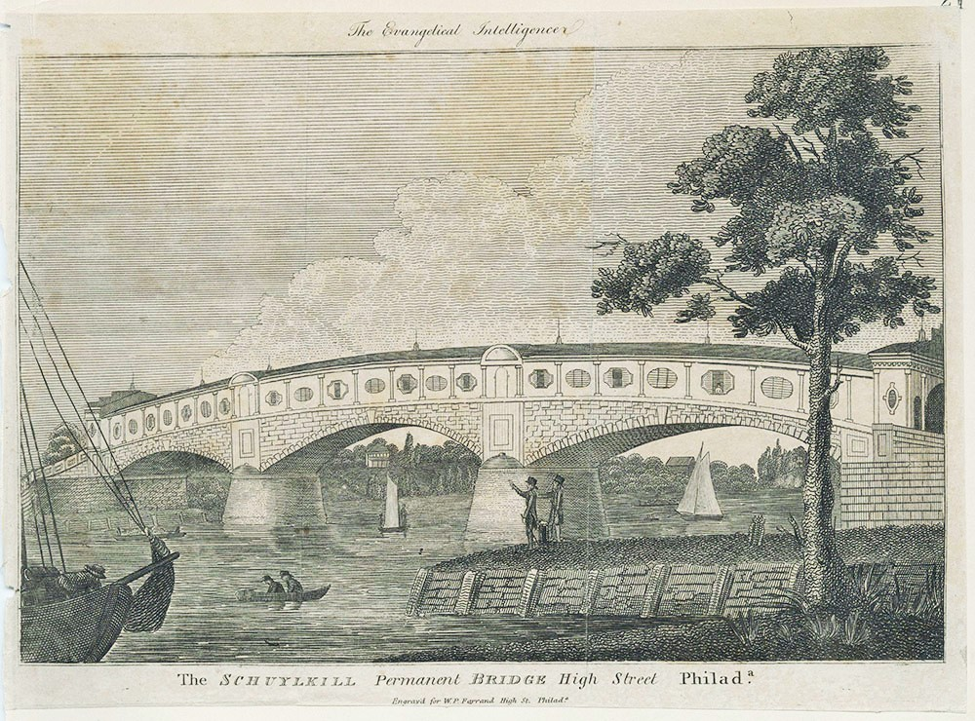
The first covered bridge in America was the Schuylkill Permanent Bridge at High Street in Philadelphia, Pennsylvania. The bridge was designed by architect Timothy Palmer, and the woodwork and ornamentation was designed by Owen Biddle. Completed in 1805, the bridge was widened in 1850 and remained in continuous use until it was destroyed by fire in 1875.
As advances in iron, steel, and concrete transformed bridge engineering during the late 19th and early 20th centuries, covered wooden bridges gradually gave way to stronger materials capable of supporting heavier loads and longer spans. Many historic covered bridges were replaced with modern structures, while others were abandoned.
Despite their decline, covered bridges have remained an important part of America’s engineering heritage. Preservation efforts throughout the 20th century helped restore many of these structures, recognizing their significance not only as historic landmarks but also as examples of the ingenuity and craftsmanship of early bridge builders.
As we celebrate America’s 250th anniversary, let’s recognize the structures often taken for granted, and the generations of engineers, architects, and builders whose ingenuity has helped make America the country it is today.
References:
- Santiago Calatrava Architects and Engineers, Margaret Hunt Hill Bridge, Margaret Hunt Hill Bridge / Dallas (Overview) – Santiago Calatrava – Architects & Engineers, accessed July 9, 2026
- American Society of Civil Engineers, Chesapeake Bay Bridge-Tunnel opens, Chesapeake Bay Bridge-Tunnel opens | Civil Engineering Source | ASCE, accessed July 9, 2026
- Golden Gate Bridge Highway & Transportation District, Art Deco on a Grand Scale, Art Deco on a Grand Scale – Exhibits Area 1 | Golden Gate, accessed July 9, 2026
- History, Brooklyn Bridge, Brooklyn Bridge – Length, Timeline & Facts | HISTORY, accessed July 9, 2026
- Wyoming SHPO, Dale Creek Crossing, Dale Creek Crossing, accessed July 9, 2026
- York Bridge Concepts, Covered Wooden Bridges: History, Benefits, & Modern Applications, Covered Wood Bridges | York Bridge Concepts, accessed July 9, 2026.
- West Philadelphia Collaborative History, Schuylkill Permanent Bridge at High Street, West Philadelphia Collaborative History – Schuylkill Permanent Bridge at High Street, accessed July 9, 2026.